La forêt comme espace de renaissance amoureuse
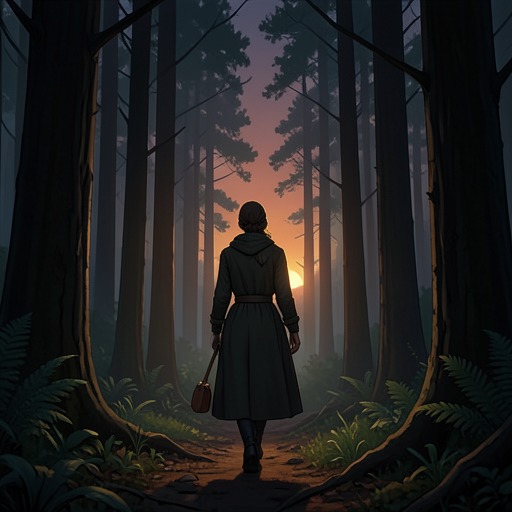
L'Amour et les ForêtsLa forêt comme espace de renaissance amoureuse is the woodland setting through which Bénédicte Ombredanne and Christian revisit their shared past and move toward renewed intimacy. It holds specific memories—the long kiss beneath a great oak and the promise of a bench where Bénédicte could read and write—while bringing them into a present encounter of walking, looking, and finally preparing to kiss again. The forest’s significance lies in this joining of remembered feeling with action now, not in any guarantee of what their relationship will become.
A return to a remembered place
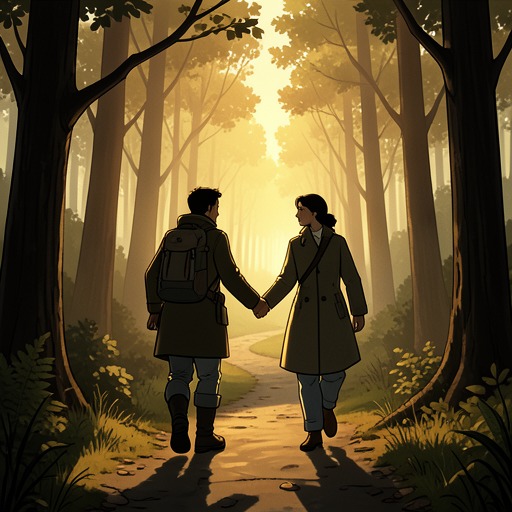
Christian invites Bénédicte to join him, and she asks to walk in the forest as they did the last time. His response stresses how limited that earlier visit was: she had come only once. The small correction makes the woodland at once familiar and scarcely explored. Their return is not a routine walk through a shared home ground; it is a deliberate resumption of a place attached to a singular encounter. When they enter the forest together, they walk close beside one another in silence. The scene allows the setting and their remembered history to precede explanation.
Bénédicte recognizes where the great oak stands and recalls a long kiss beneath it, at that precise spot. Christian says that he thinks of the kiss whenever he passes there. The tree therefore serves as more than a scenic marker: it fixes a past moment in a location that remains part of his recurring landscape. Bénédicte’s recognition and Christian’s repeated remembrance meet in the same place, making the forest a shared archive of their intimacy. Their memories are not identical in form, but the oak gives them a common point from which to approach the present.
Images, words, and the planned bench
The forest also carries a small promise from the earlier meeting into the current one. Bénédicte notices that Christian has installed the bench he once described: a place where she might read good books and write poems in summer shade. The bench is a practical object, but its meaning comes from that remembered plan. It makes the past tangible without reproducing it exactly: what had been spoken of as an imagined place for reading and writing now exists in the landscape.
Their exchange distinguishes between visual memory and literary memory. Christian identifies himself with images, while Bénédicte identifies herself with literature; he remembers the images of their day, and she has kept their lines in mind. The forest consequently holds two ways of preserving the encounter. The oak and the remembered kiss belong to its visual record; the proposed bench and the promise of poems belong to its verbal and literary one. Christian had imagined Bénédicte as the heroine of poems he would send her, binding the woodland setting to an act of address as well as to physical closeness. These details make the forest a place where an earlier version of their connection can be recalled, examined, and approached again.
The valley and the isolated tree
As they continue, Christian leads Bénédicte toward a panorama. She is surprised when a valley opens into view. He explains that the land beyond their position belongs to a farmer, whose farm lies lower down; cattle are normally behind a fence, though they are absent now. Across the meadows, on the opposite hill, lies another forest where he often walks. He describes a route down to a stream and a large pond, then up a pleasant path toward those woods. The forest is thus not a sealed enclosure. It opens onto farmland, water, slopes, and another stretch of woodland, and Christian offers a choice between continuing the walk and returning home.
Among the landscape’s details, Christian singles out an isolated prairie tree as especially beautiful. He contrasts its broad, rounded growth, exposed to sun on all sides, with the straight, high growth of a forest tree competing with its neighbors for light. The latter yields straighter, branchless trunks suitable for boards; the prairie tree, he observes, is of little practical use beyond being looked at or offering summer shade. His extended attention shifts the walk from travel through scenery to an act of looking together. The tree’s value rests precisely in its presence and form, not in its usefulness as timber. In a scene centered on a love that persists in remembered images, this distinction gives the landscape an intimate emphasis: to look, remember, and share the view are themselves worthwhile.
A renewed approach, not a promised ending
The walk joins recollection to a new physical gesture without making the past and present interchangeable. The earlier kiss is remembered at the oak; later, beside the prairie tree, Christian says that he believes the moment has come for them to kiss. The movement between these points matters: their renewed intimacy is not simply a repetition staged at the original site, but an action reached after walking, conversation, and attention to a wider landscape. The forest makes room for both the return of the old memory and a distinct present decision.
The scene’s renewal remains deliberately limited to what it shows. Bénédicte and Christian walk together, recall what they shared, and approach another kiss; the setting intensifies that return by giving memory precise places and objects. Yet neither the bench nor the remembered oak can establish a lasting reconciliation or secure a future for the relationship. The forest’s force is more immediate and more fragile: within it, an earlier intimacy can be recalled as something still capable of being felt, and the present can briefly answer that memory.